The Big Bang, The Moments After, & The Now!

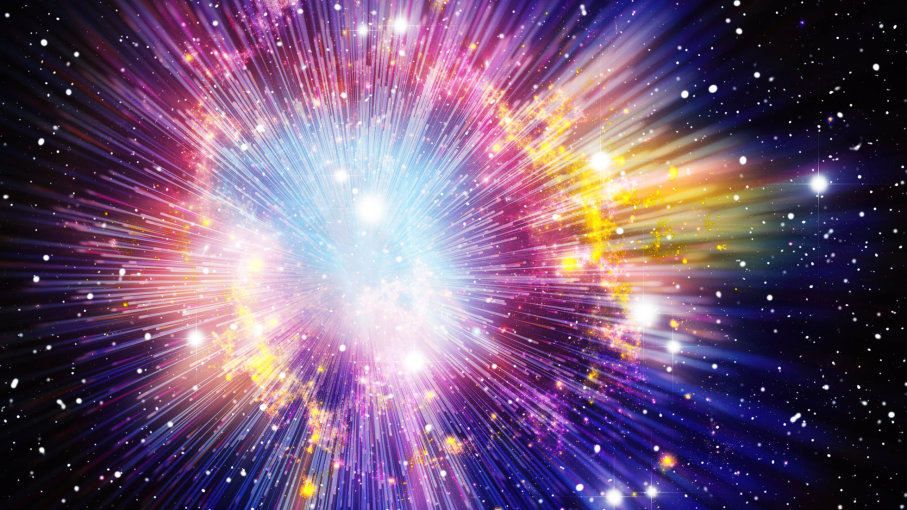
An Image Depicting What The Big Bang Looked Like!

Scientists have estimated that the new universe took 380k years to cool off enough for electrons to move slow enough to create hydrogen, helium, and lithium atoms. What’s even more interesting is the Sun is composed of 554 million tons of hydrogen being rapidly converted to 550 tons of helium per second. This conversion creates electric storms or what we call Soul-ar InnerG.The Sun/Son is a source of electricity that holds this galaxy in its magnetic pull. Jesus is named EmmanuEL for electricity and his wife Mary MAGdelene is magnetism. This becomes even more interesting when we see that 5 + 5 + 4 + 5 + 5 + 0 = 24. The planet is 24896 miles in circumference and the Solar equinox in some ancient cultures was charted by 4 6000 year cycles or 24k years. To couple, this with the estimate of the universe taking 380k years to create atoms we see 3 + 8 + 0 = 11 and the 11th attribute of Allah is Al Khalaqa the creator. The 11th Hebrew alphabet is Kaf and the 11th letter in the English alphabet is K. The 11th letter in Greek is Lambda and the Lambda sequence is what Plato said God used to create the Cosmic soul! 

Life Could Have Evolved Just 15 Million Years After The Big Bang, Says Cosmologist

In the hot afterglow of the Big Bang, warm watery conditions could have existed on almost any rocky planet in the Universe, according to new calculations

One of the key questions for astrobiologists is where in the universe life might have taken hold. Their standard approach is to look for places that are warm enough to keep water in liquid form and so allow chemistry similar to our own.

That’s given rise to the idea of circumstellar habitable zones—regions around stars that are not too hot and not too cold but just right for liquid water. Goldilocks zones as they are sometimes called.

But in recent years, planetary geologists have pointed out that various other mechanisms might keep planets and moons warm enough for liquid water. For example, tidal heating can generate considerable heat. This is the squeezing and squashing of a body as it moves through a powerful gravitational field and the process that maintains a salty ocean beneath the ice on Jupiter’s moon Europa. Radioactive decay also generates heat and keeps the interior of our planet warm.

Now Abraham Loeb at Harvard University in Cambridge says there is another mechanism that creates a Goldilocks zone but in this case the zone is in time rather than in space. He says this mechanism would have created a Goldilocks zone that filled the entire universe for a few million years soon after the Big Bang. If he’s right, that means life could have evolved some 10 billion years before it cropped up on Earth.

The key phenomenon in Loeb’s reasoning is the cosmic microwave background radiation, the afterglow of the Big Bang which fills the universe with light.

This radiation was once blazing hot. But as the universe has expanded, the wavelength of this light has increased and become less energetic. Today, it is freezing with a temperature of around 3 Kelvin.

Loeb points out that as it cooled, at some point this radiation must have once been amenable to life. Indeed, it would have been warm enough to maintain water in liquid form on a planet, regardless of its distance from its parent star.

And Loeb has calculated exactly when. He says the cosmic microwave background radiation would have had a temperature of between 273 and 300 Kelvin (between 0 and 30 degrees C) about 15 million years after the Big Bang and this would have lasted for several million years. That would have allowed “the chemistry of life to possibly begin when the Universe was merely 15 million years old,” he says.

That’s an exciting possibility but one that comes with a number of caveats. The first is the question of whether planets could have formed at all at this stage of the universe.

The question arises because to start with, the cosmos was filled only with hydrogen and helium. The heavier elements were forged inside stars and so came later.

So an important question is whether the cycle of heavy element formation could have advanced enough in these 15 million years to allow rocky planets to have formed along with the variety of elements necessary for the chemistry of life.

Loeb is optimistic on this point. He calculates that the first stars, which would have been tens to hundreds of times more massive than the Sun, had a lifespan of about 3 million years. And although they would not have formed immediately after the Big Bang, he calculates there ought to have been time enough for heavy element formation in 15 million years.

So the conditions were certainly possible that would have “triggered the formation of rocky planets with liquid water on their surface,” he says.

A much bigger question is whether life could have evolved in these conditions and in this timescale. That’s something that Loeb is unable to help with.

Nevertheless, this a fascinating idea. If life did evolve during the Universe’s Goldilocks epoch, it would have predated life on Earth by 10 billion years.
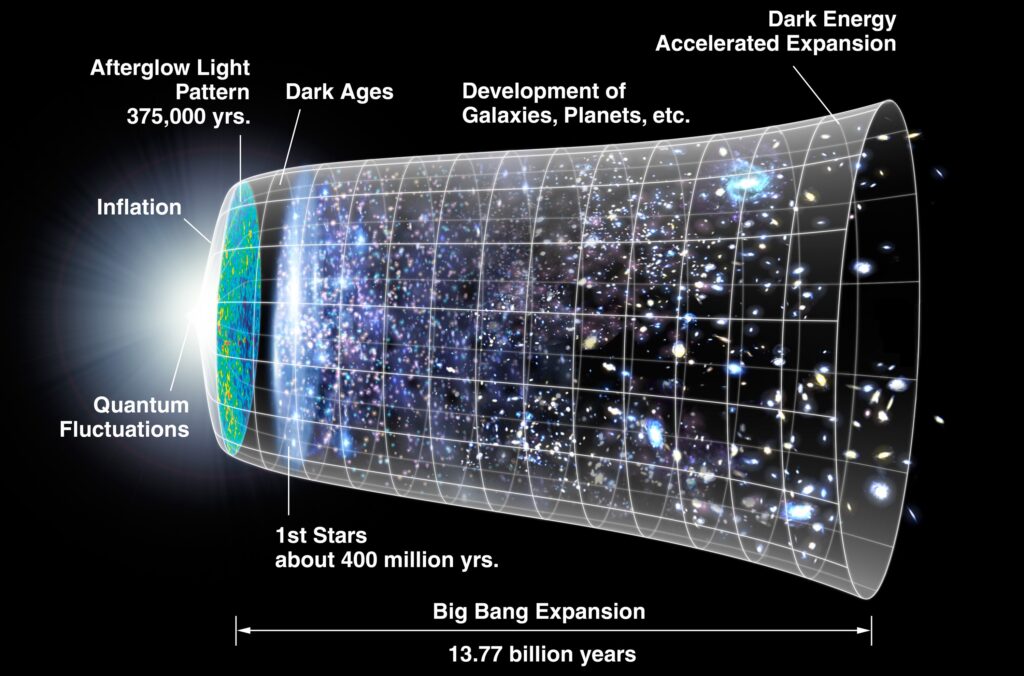
An Image Showing The Universe’s Evolution From Dark Energy

THE FOLLOWING IS A TIMELINE OF HISTORY COUNTING BACK TO THE BIG BANG!

60 years ago – Invention of the computer.

130 years ago – Invention of the telephone.

180 years ago – Fossil fuel revolution: coal, trains.

540 years ago – Invention of the printing press.

5,500 years ago – Invention of the wheel, writing.

7,600 years ago – Sahara desert starts forming in northern Africa.

8,800 years ago – The first cities.

10,300 years ago – End of the most recent glacial period: the Wisconsin glaciation.

12,700 – 11,500 years ago – the Younger Dryas.

18,000 years ago – Cultivation of plants, herding of animals. Homo sapiens arrives in the Americas.

21,000 years ago – Last glacial maximum: ice sheets down to the Great Lakes, the mouth of the Rhine, and covering the British Isles.

32,000 years ago – Oldest known cave paintings.

35,000 years ago – Invention of the calendar, extinction of Homo neanderthalensisHomo sapiens arrives in Europe.

50,000 years ago – Homo sapiens arrives in central Asia.

100,000 years ago – Homo sapiens arrives in the Middle East.

110,000 years ago – Beginning of the most recent glacial period: the Wisconsin glaciation.

130,000 years ago – Beginning of the Eemian interglacial.

200,000 years ago – Beginning of the 2nd most recent glacial period: the Wolstonian glaciation.

250,000 years ago – First Homo sapiens.

350,000 years ago – First Homo neanderthalensis.

380,000 years ago – Beginning of the Hoxnian interglacial.

450,000 years ago – Beginning of the 3rd most recent glacial period: the Kansan glaciation, during which ice sheets reached their maximum extent in the Pleistocene, down to Kansas and Slovakia.

620,000 years ago – Beginning of the Cromerian interglacial.

1.4 million years ago – First firemaking by humans.

1.9 million years ago – First Homo erectus.

2.5 million years ago – First Homo habilis. Beginning of a period of repeated glaciation (loosely speaking, “ice ages”).

3 million years – Cooling trend causes year-round ice to form at the North Pole.

3.9 million years ago – First known Australopithecus afarensis.

5 million years ago – Humans split off from other apes (gorillas and chimpanzees).

21 million years ago – Apes split off from other monkeys.

24 million years ago – Cooling trend causes the formation of grasslands; Antarctica becomes covered with ice.

34 million years ago – Gondwanaland finishes breaking up, with Australia and South America separating from Antarctica.

50 million years ago – India begins to collide with Asia, eventually forming the Himalayas.

67 million years ago – Asteroid hits Mexico, causing the Cretaceous-Tertiary extinction. End of dinosaurs. 50% of all species died out! Intensification of world cooling trend.

114 million years ago – First modern mammals. World begins to cool.

150 million years ago – First birds.

200 million years ago – Pangaea began to split into separate continents: Gondwana to the south and Laurasia to the north, separated by the Tethys Sea.

205 million years ago – The Triassic-Jurassic extinction. End of large amphibians and many reptiles.

235 million years ago – First dinosaurs, flowers.

250 million years ago – The Permian-Triassic extinction. 90% of all species died out! Formation of the supercontinent Pangaea, with surrounding ocean Panthalassa.

313 million years ago – First reptiles.

365 million years ago – The Late Devonian extinction. 70% of marine species died out! First amphibians, trees.

395 million years ago – First insects on land.

415 million years ago – The Old Red Sandstone Continent, also known as Laurussia, is formed by the collision of Baltica and Laurentia at the beginning of the Devonian.

440 million years ago – The Ordovician-Silurian extinction. Most marine species died out.

670 million years ago – First animals.

630-850 million years ago – The Cryogenian Period, also known as Snowball Earth – the worst ice age in the Earth’s history.

800 million years ago – The supercontinent Rodinia begins to break up.

1 billion years ago – Formation of the supercontinent Rodinia

1.3 billion years ago – First plants.

1.6 billion years ago – First blue-green algae.

2.4 billion years ago – The Great Oxidation Event: the Earth’s atmosphere gets oxygen.

3 billion years ago – Formation of the first known continent, Ur.

3.8 – 4 billion years ago – The Late Heavy Bombardment: a period during which the Earth, Moon, Venus and Mars were subjected to many asteroid impacts, after a relatively calm period of several million years.

4 billion years ago – First life on Earth.

4.45 billion years ago – Formation of Earth complete; storm of asteroid impacts.

4.5 billion years ago – Formation of the Moon: according to the Giant Impact Hypothesis, this happened when Theia collided with proto-Earth.

4.55 billion years ago – Formation of the Solar System.

13.3 billion years ago – Reionization: the first stars heat and ionize hydrogen gas.
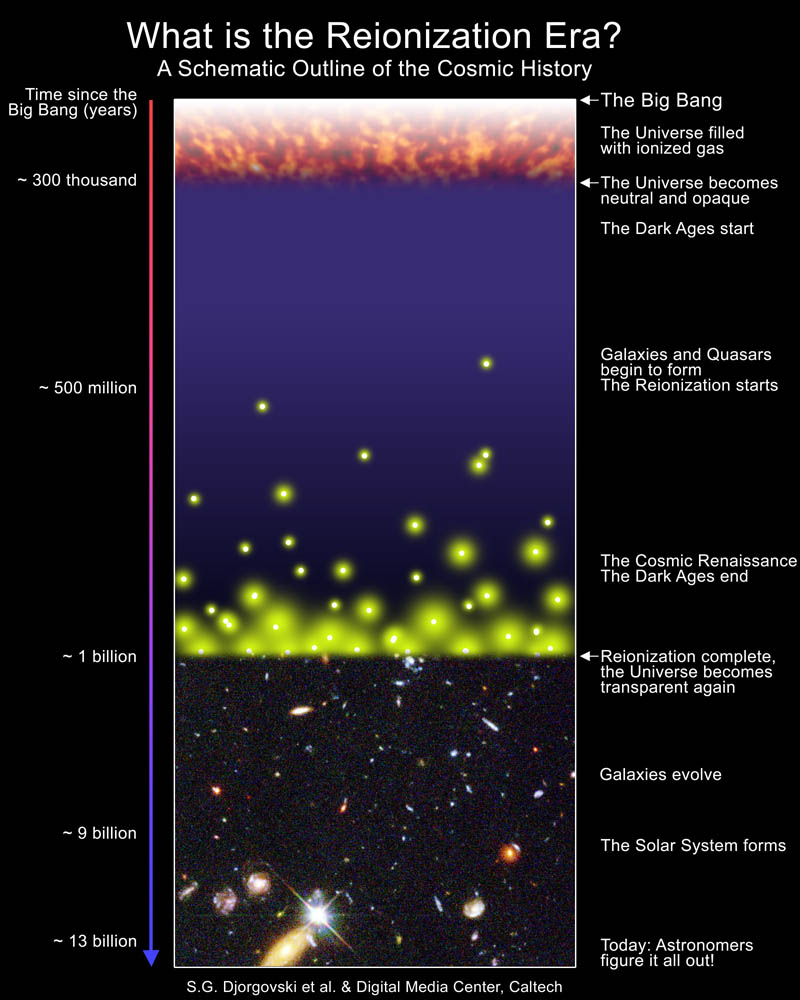
An Image Depicting The Re-ionization Era

13.3 – 13.7 billion years ago – The Dark Ages, after the formation of hydrogen and before the first stars.

13.7 billion years ago – The Big Bang: beginning of the universe as we know it!

In what follows I give the temperature of outer space in Kelvin at various times. Kelvin means “degrees Celsius above absolute zero”. The melting point of water is 273 Kelvin; the boiling point is 373 Kelvin.

13.7 billion years after the Big Bang – Now.
Temperature: 2.726 Kelvin

550 million years after the Big Bang – Reionization: first stars heat and ionize hydrogen gas.
Temperature: roughly 30 Kelvin.

380 thousand years after the Big Bang – Recombination: hydrogen gas cools down to form molecules.
Temperature: 3000 Kelvin.

10 thousand years after the Big Bang – End of the radiation-dominated era.
Temperature: 12,000 Kelvin.

1000 seconds after the Big Bang – Decay of lone neutrons.
Temperature: roughly 500 million Kelvin.

180 seconds after the Big Bang – Beginning of nucleosynthesis: formation of helium and other elements from hydrogen
Temperature: roughly 1 billion Kelvin.

10 seconds after the Big Bang – Annihilation of electron-positron pairs.
Temperature: roughly 5 billion Kelvin.

1 second after the Big Bang – Decoupling of neutrinos.
Temperature: roughly 10 billion Kelvin

100 microseconds after the Big Bang – Annihilation of pions.
Temperature: roughly 1 trillion Kelvin

50 microseconds after the Big Bang – “QCD phase transition”: quarks get bound into neutrons and protons.
Temperature: 1.7-2.1 trillion Kelvin

10 picoseconds after the Big Bang – “Electroweak phase transition”: electromagnetic and weak force become different.
Temperature: 1-2 quadrillion Kelvin

FOLLOW

iNSTAGRAM REDPILLGANG99

https://www.facebook.com/dewayne.hendrix

https://www.facebook.com/groups/257379211490785/

https://www.facebook.com/SupremeScience99/

Sources https://medium.com/the-physics-arxiv-blog/life-could-have-evolved-just-15-million-years-after-the-big-bang-says-cosmologist-239bc4cf4ece

http://math.ucr.edu/home/baez/timeline.html
TAKE THE RED PILL NEO!
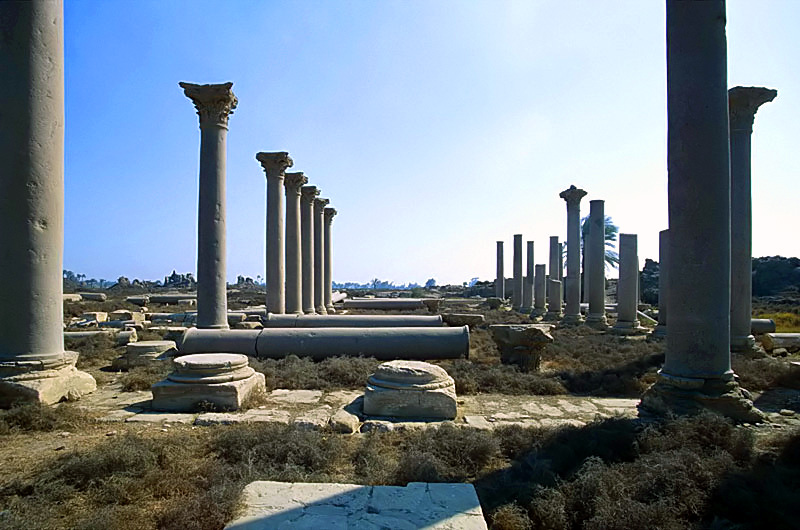
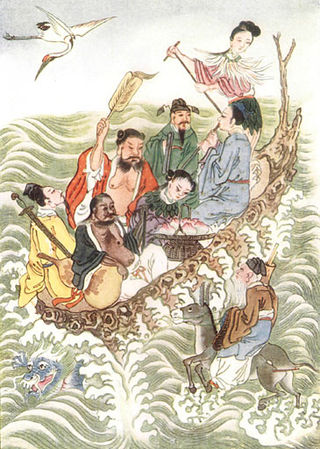
The 8 Immortals of Han Xiangzi or The 8 Khemenu of Tehuti? You Decide!

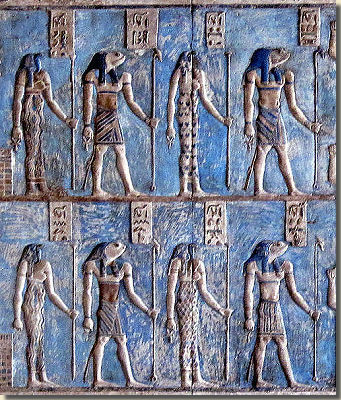
The Temple of Thoth Tehuti of Hermopolis

The following is an explanation of the 8 Immortals of Chinese folklore!

The Eight Immortals (Chinese: 八仙; pinyinBāxiānWade–GilesPa¹-hsien¹) are a group of legendary xian (“immortals”) in Chinese mythology. Each immortal’s power can be transferred to a vessel (法器) that can bestow life or destroy evil. Together, these eight vessels are called the “Covert Eight Immortals” (暗八仙). Most of them are said to have been born in the Tang or Shang Dynasty. They are revered by the Taoists and are also a popular element in secular Chinese culture. They are said to live on a group of five islands in the Bohai Sea, which includes Mount Penglai.

The Immortals are:

  • He Xiangu (何仙姑), this particular immortal is considered female.
  • Cao Guojiu (曹國舅), a princely actor among the eight.
  • Li Tieguai (李鐵拐), he is considered to be a male immortal who is also mentally disturbed.
  • Lan Caihe (藍采和), this particular immortal and their gender is considered to be ambiguous.
  • Lü Dongbin (呂洞賓), he is considered to be their leader.
  • Han Xiangzi (韓湘子), he is a flute artist among the eight.
  • Zhang Guolao (張果老), he is associated with old age.
  • Zhongli Quan (鍾離權), he is associated with death.

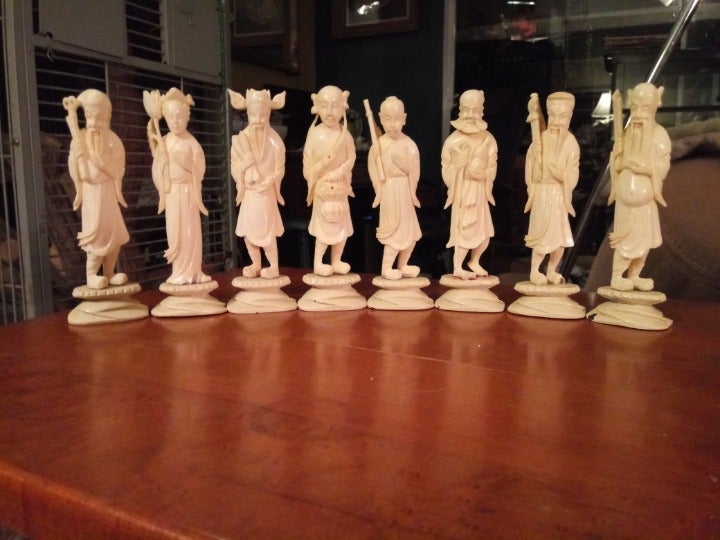
Statues of The 8 Immortals

In artwork

The Immortals are the subject of many artistic creations, such as paintings and sculptures. Examples of writings about them include:

The tradition of depicting humans who have become immortals is an ancient practice in Chinese art, and when religious Taoism gained popularity, it quickly picked up this tradition with its own immortals. While cults dedicated to various Taoist immortals date back to the Han dynasty, the popular and well-known Eight Immortals first appeared in the Jin dynasty. The art of the Jin tombs of the 12th and 13th centuries depicts a group of eight Taoist immortals in wall murals and sculptures. They officially became known as the Eight Immortals in the writings and works of art of the Taoist group known as the Complete Realization (Quanshen). The most famous art depiction of the Eight Immortals from this period is a mural of them in the Eternal Joy Temple (Yongle Gong) at Ruicheng.

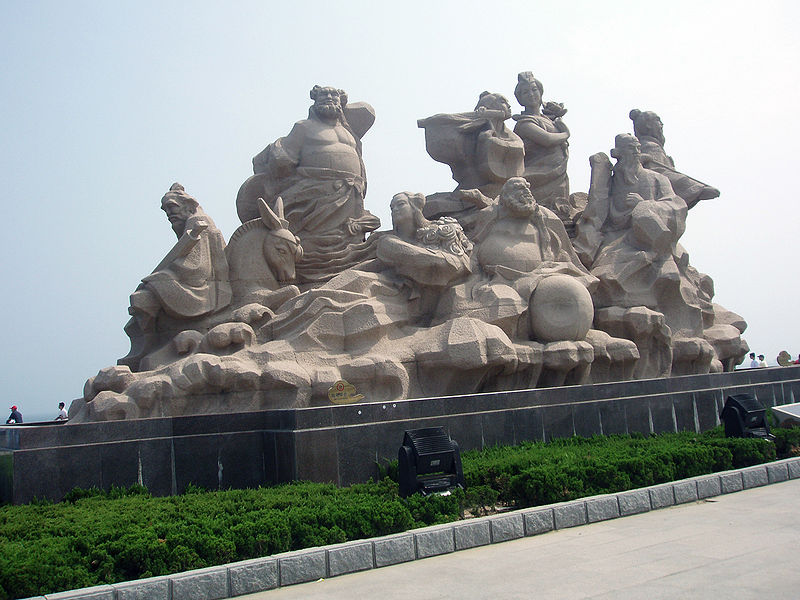
The 8 Immortals Statue in Penglai

The Eight Immortals are considered to be signs of prosperity and longevity, so they are popular themes in ancient and medieval art. They were frequent adornments on celadon vases. They were also common in sculptures owned by the nobility. Their most common appearance, however, was in paintings. Many silk paintings, wall murals, and woodblock prints remain of the Eight Immortals. They were often depicted either together in one group, or alone to give more homage to that specific immortal.

An interesting feature of early Eight Immortal artwork is that they are often accompanied by jade handmaidens, commonly depicted servants of the higher ranked deities, or other images showing great spiritual power. This shows that early on, the Eight Immortals quickly became eminent figures of the Taoist religion and had great importance. We can see this importance is only heightened in the Ming and Qing dynasties. During these dynasties, the Eight Immortals were very frequently associated with other prominent spiritual deities in artwork. There are numerous paintings with them and the Three Stars (the gods of longevity, prosperity, and good fortune) together. Also, other deities of importance, such as the Queen Mother of the West, are commonly seen in the company of the Eight Immortals.

The artwork of the Eight Immortals is not limited to paintings or other visual arts. They are quite prominent in written works too. Authors and playwrights wrote numerous stories and plays on the Eight Immortals. One famous story that has been rewritten many times and turned into several plays (the most famous written by Mu Zhiyuan in the Yuan Dynasty) is The Yellow-Millet Dream, which is the story of how Lǚ Dòngbīn met Zhongli Quan and began his path to immortality.

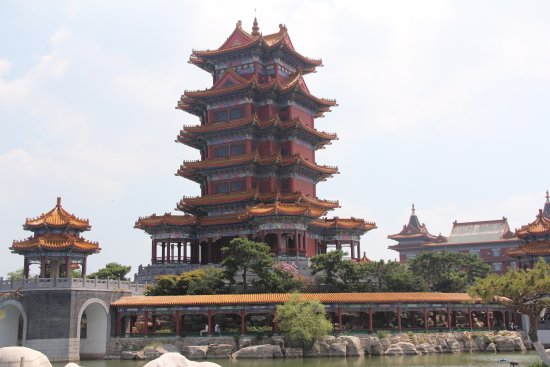
The 8 Immortals Pavillion Just Outside of Penglai

In literature

In literature before the 1970s, they were sometimes translated as the Eight Genies. First described in the Yuan Dynasty, they were probably named after the Eight Immortal Scholars of the Han.

  • The Yueyang Tower by Ma Zhiyuan
  • The Bamboo-leaved Boat (竹葉船; zhú yè chuán) by Fan Zi’an (范子安; fàn zǐ ān)
  • The Willow in the South of the City (城南柳; chéng nán liǔ) by Gu Zijing (谷子敬; gǔ zǐ jìng)
  • The most significant is The Eight Immortals Depart and Travel to the East (八仙出處東遊記; bā xiān chū chù dōng yoú jì) by Wu Yuantai (吳元泰; wú yuán taì) in the Ming Dynasty.
  • There is another work, also made during the Ming (c. 14th-15th centuries), by an anonymous writer, called The Eight Immortals Cross the Sea (八仙過海; bā xiān guò hǎi). It is about the Immortals on their way to attend the Conference of the Magical Peach (蟠桃會; pán taó huì) when they encounter an ocean. Instead of relying on their clouds to get them across, Lü Dongbin suggested that they each should exercise their unique powers to get across. Derived from this, the Chinese proverb “The Eight Immortals cross the sea, each reveals its divine powers” (八仙過海,各顯神通; bā xiān guò hǎi, gè xiǎn shén tōng) indicates the situation that everybody shows off their skills and expertise to achieve a common goal.

The 8 Immortals Seen In A Boat Crossing The Sea

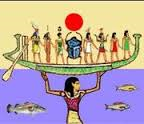
The Solar Boat of Ra Showing A Sun Disk With 8 Deities On Board! Notice That Even Though The Sun Is Present There Are Fish Being Shown!

The following is an explanation of the Khemenu from the standpoint of the Greeks. The Greeks referred to the Khemenu as the Ogdoads meaning 8!

In Egyptian mythology, the Ogdoad (Ancient Greek: ὀγδοάς “the Eightfold”; Ancient Egyptianḫmnyw, a plural nisba of ḫmnw “eight”) were eight primordial deities worshiped in Hermopolis.

References to the Ogdoad date to the Old Kingdom of Egypt, and even at the time of composition of the Pyramid Texts towards the end of the Old Kingdom, they appear to have been antiquated and mostly forgotten by everyone except religious experts. They are frequently mentioned in the Coffin Texts of the Middle Kingdom. The oldest known pictorial representations of the group do not predate the time of Seti I (New Kingdom, 13th century BC), when the group appears to be rediscovered by the theologians of Hermopolis for the purposes of a more elaborate creation account.

Texts of the Late Period describe them as having the heads of frogs (male) and serpents (female), and they are often depicted in this way in reliefs of the Ptolemaic Kingdom.

The eight deities were arranged in four male-female pairs. The female names are derivative of the male names.

The names of Nu and Naunet are written with the determiners for sky and water, and it seems clear that they represent the primordial waters.

The fourth pair appears with varying names; sometimes the name Qerḥ is replaced by Ni, Nenu, Nu, or Amun, and the name Qerḥet by Ennit, Nenuit, Nunu, Nit, or Amunet. The common meaning of qerḥ is “night”, but the determinative (D41 for “to halt, stop, deny”) also suggests the principle of inactivity or repose.

Ḥeḥu and Ḥeḥut have no readily identifiable determiners; according to a suggestion due to Brugsch (1885), the name is associated with a term for an undefined or unlimited numberḥeḥ, suggesting a concept similar to Greek aion. But from the context of a number of passages in which Ḥeḥu is mentioned, Brugsch also suggested that he may be a personification of the atmosphere between heaven and earth (c.f. Shu).

The names of Kekui and Kekuit are written with a determiner combining the sky hieroglyph with a staff or scepter used for words related to darkness and obscurity, and kkw as a regular word means “darkness”, suggesting that these gods represent primordial darkness, comparable to Greek Erebus, but in some aspects they appear to represent day as well as night, or the change from night to day and from day to night.

The Khemenu In Hermopolis

The fourth pair has no consistent attributes as it appears with varying names. The common meaning of qerḥ is “night”, but the determinative (D41 for “to halt, stop, deny”) also suggests the principle of inactivity or repose.

There is no obvious way to allot or attribute four functions to the four pairs of gods, and it seems clear that “the ancient Egyptians themselves had no very clear idea” regarding such functions. Nevertheless, there have been attempts to assign “four ontological concepts” to the four groups. For example, in the context of the New Kingdom, Karenga (2004) uses “fluidity” (for “flood, waters”), “darkness”, “unboundedness” and “invisibility” (for “repose, inactivity”).

This explanation based on the Greek’s interpretation is precisely why we see their comprehension of our sciences is mediocre at best. We must begin to overstand that this can be viewed as a clear cut indication as to why those that have tried to take ownership of our original sciences have failed miserably. The Greeks interpretation incorporates cosmological metaphor/as above but fails to give the applicable/so below meaning! The above picture of the Solar Boat of Ra with fish in the scene depicts that the boat used in the story of the 8 Immortals relates to the cosmos or Nun! The primordial waters or the sea actually refer to the cosmos! This is also why a nun wears the outfit of black/cosmos/Nun. The outfit also is meant to resemble a fish, I will explain this in another article, however!

The 8 Ogdoads or Khemenu are also found in Ancient Sumerian culture as well. They are referred to as The 4 Sets of Adam in Esoteric circles! The following excerpts are from Supreme Science Volume 1 Does The Matrix Really Exist!

The four sets of Adam and Eve were originally referred to as the 8 Ogdoads or Pa Khemenu, and they existed when this was a complete water planet. These four sets represented genetic shifts every for generations giving birth to various humims that would eventually dwell on the dry land that later appeared.

The first set of Adam and Eve were thus Sumerian Apsu meaning “ one who existed from the beginning ” and Tiamat meaning “maiden of life “they were known to the Ancient Egiptians as Nun meaning ” supreme being of the ocean ” and Nunet meaning “female supreme being of the oceans”   Gods over the deep.

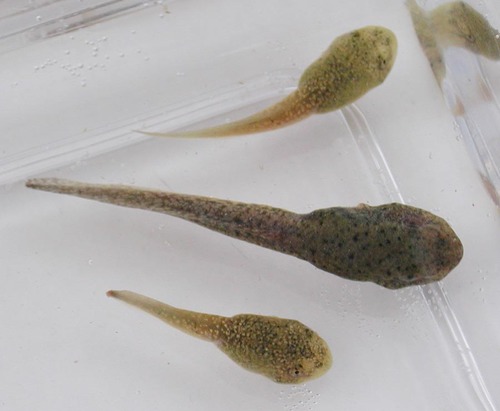
The second set of Adam and Eve word Sumerian Lahmu, meaning” deity of war” and Lahamu, meaning ” lady of battles ” and who was known to the Ancient Egiptians as Heh meaning “the supreme being of immeasurable as in time, or Neter of infinity” represented by tadpoles, each of which symbolizes 10,000 years; and Hehet meaning “female supreme being of immeasurable; Heh was also called the supreme being of chaos. They were destroyed 17,250,000 years ago by a meteorite shower and sandstorms.

The third set of Adam and Eve were the Sumerian Anshar, meaning “foremost of the heavens”, and Kishar meaning “foremost of the firmaments.” Who were known to the Ancient Egiptians as Kek, meaning “supreme being of darkness, void and darkness”, and Keket meaning “female supreme being of darkness “they were destroyed by a second meteorite shower 14,250,000 years ago. 

The aforesaid of Adam and Eve were Zakar meaning “remember” and Nekaybaw meaning ” female tribal leader ” who you know as the Adam meaning ” life blood “, and Eve meaning Hawwah [female living being] means “mother of all living.” Of the Hebrew Bible today.

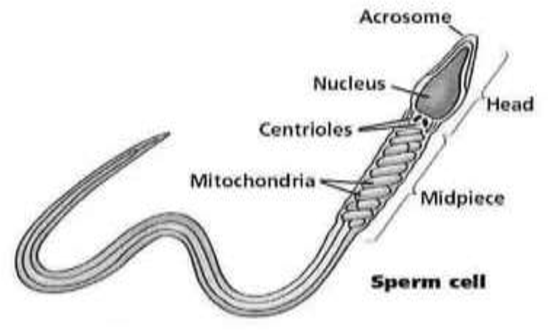
The Tadpole of a Bull Frog Showing The Resemblance To A Human Sperm Cell!

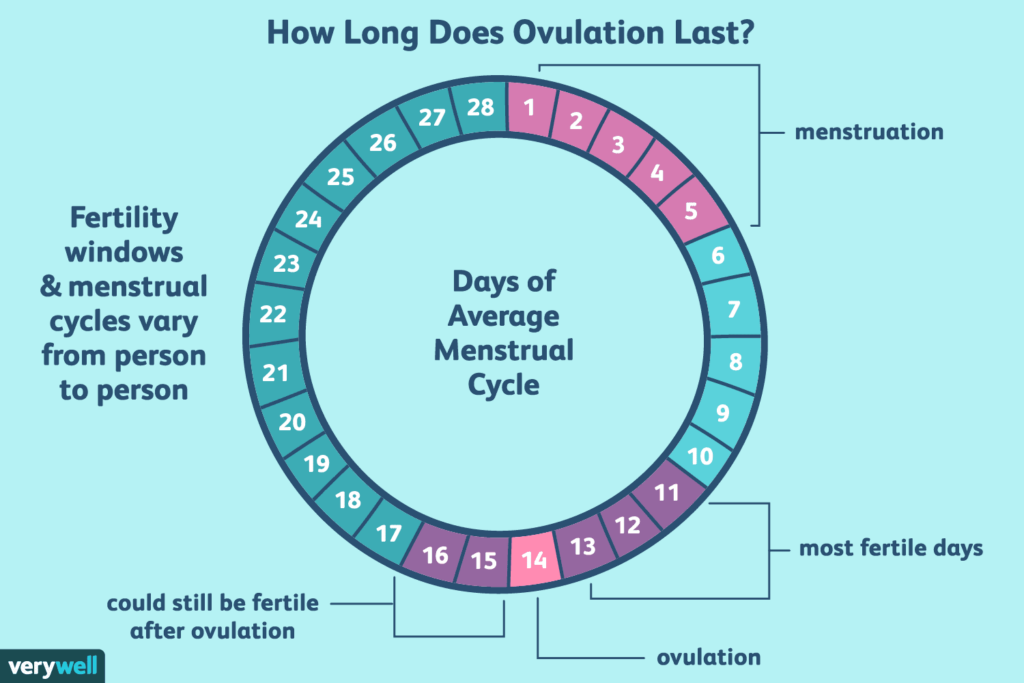
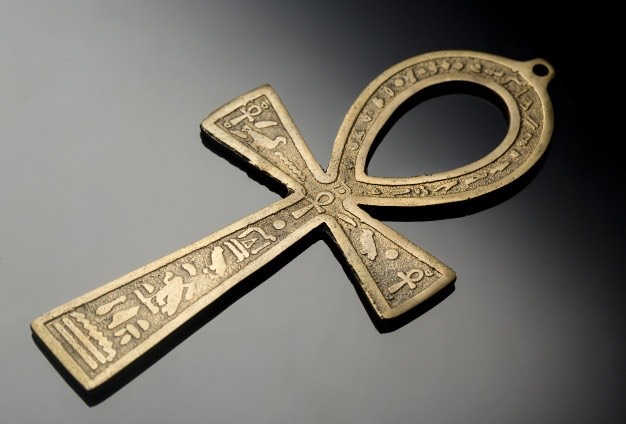
These four sets represent the four phases of evolution from the reptilian, to Genus Homo, to Homo Erectus, to Homo Sapien! This science coincides with the pregnancy of a woman! The reptilian phase is the fertility phase! A woman’s body ovulates monthly. In a 28 day cycle, a woman’s peak day during ovulation is usually the 14th day! This science is why the 4th set of Adam and Eve refers to Amun and Amunet in Egipt! Overstanding the significance of the mysteries is important because Adam & Eve as well as Amun & Amunet refer to Ausar and Auset! Knowing this we can now see why 14 is a number connected to Ausar and the original resurrection story! The resurrection shows the word erection inside and this is why Ausar’s phallus was swallowed by a big fish! This concept was also adopted in the story of Jonah! The three days can be deemed a metaphor explaining the 3 trimesters of pregnancy! Now can you see how the primordial waters or the sea of Nun also pertain to the waters of the womb Neo? How is that the Chinese stoe your original creation story and used it in mythology, art, and literature but you don’t even want to learn it? In closing let’s look at the first letter in each set of the Khemenu! We see the letters ANKH, the ankh is known as the “key of life” in Ancient KMT/TamaRe/Egipt!

The 14th Day Is The Day of Ausar Resurrecting Himself As Heru Through Auset! The ANKH The Key Life Representing Man, Woman, & Child!

NOW DOES IT MAKE SENSE THAT THE KHEMENU EXPLAIN THE PROCESS OF EVOLUTION IN THE WOMB NEO?

To Learn More About Ausar & The Number 14 Check Out This Previous Article

https://supremescience99.com/2019/11/the-science-magic-of-the-number-14-the-deity-ausar-the-hand-of-god/

sOURCES

https://en.wikipedia.org/wiki/Eight_Immortals

https://en.wikipedia.org/wiki/Ogdoad_(Egyptian)

JOIN

https://www.facebook.com/groups/257379211490785/

FOLLOW https://www.facebook.com/SupremeScience99/

Khemenu Clothing The Flyest Kemetic Line There Is!

SUPPORT SUPPORT SUPPORT

Khemenu Clothing Link!

https://ebay.to/3eTndyU

Supreme Science on Amazon! THIS BOOK WILL CHANGE YOUR LIFE!

https://amzn.to/2Y2S70H